30 May 2016 - Limoges, France
Almost one year ago, I attended my first ever mammogram examination. With no family history of cancer, having never smoked cigarettes, eating a healthy diet and being of average weight, I was confident that I would receive a 'normal' mammogram result. The radiologist completed the mammogram; indeed, 'normal' - no abnormalities. However, I was directed to the next room where I received an ultrasound examination. A small shadow was detected on my left breast, perhaps no reason for concern, maybe a cyst? An appointment was booked for a biopsy. One week later, I was diagnosed with breast cancer - an 8mm Invasive Ductal Carcinoma (or IDC).
Early Detection
Apparently I was lucky! Of course, to be diagnosed with cancer was a huge shock. However, what was clear was that without supplemental screening ultrasound, my tumour would not have been detected. Unfortunately, ultrasound is not offered in the national screening programme in the UK unless a woman presents symptoms. My next screening mammogram would have been 3 years on and the outcome would likely have been quite different.

Knowledge is Power
Immediately I began to research IDC. I needed to educate myself. As a retired teacher, I wanted to learn all about breast cancer. I was surprised and fascinated to discover the issue of dense breasts.
Why Does Breast Density Matter?
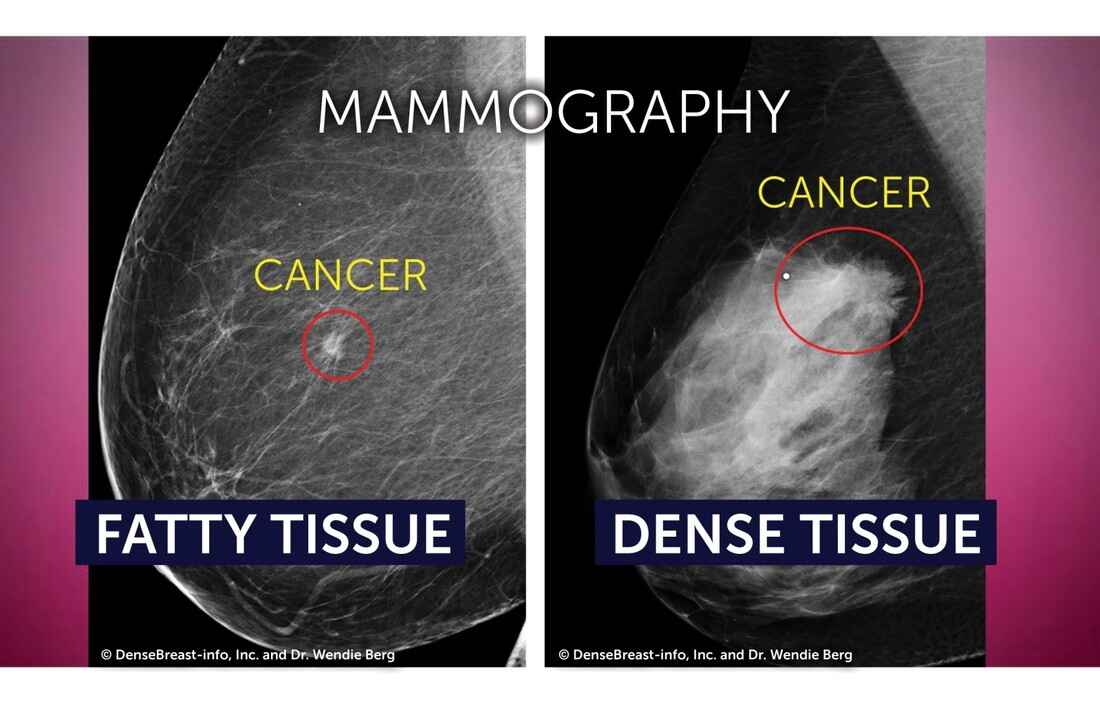
I discovered that breasts are made up of glandular and fatty tissue and whilst dense breasts are not abnormal, mammography is not as effective detecting cancers in women with highly dense breast tissue. On a mammogram image, dense tissue appears white, but so does cancer, almost like a fog. Cancers can go undetected and sometimes women are diagnosed later with interval cancers at a more advanced stage which require more treatment.
Knowledge is Power
Immediately I began to research IDC. I needed to educate myself. As a retired teacher, I wanted to learn all about breast cancer. I was surprised and fascinated to discover the issue of dense breasts.
Knowledge is Power
Immediately I began to research IDC. I needed to educate myself. As a retired teacher, I wanted to learn all about breast cancer. I was surprised and fascinated to discover the issue of dense breasts.

Breast Density Matters UK - Campaign
During my research, I found a woman in the UK, who had dense breasts. She had found a lump and she had decided to have a mastectomy. She discovered by chance (seeing her medical notes) that within the removed breast, there had been a large tumour hidden in her dense breast. I contacted her and discovered that she had begun a Breast Density campaign back in 2013. In fact, I found more women in the UK who had dense breasts; who had received 'normal' mammograms, and then later been diagnosed with more advanced cancers. I had avoided all of this. Not only was I lucky but I was totally compelled to do something. I decided to re-launch the Breast Density campaign.
Our Mission
In one year, Breast Density Matters UK has gained worldwide support from breast cancer survivors as well as breast cancer experts; surgeons, radiologists, scientists, and cancer organisations who promote patient empowerment. We believe that women NEED to be educated about their breast density in order that they can make an informed decision about their breast health. Doctors and other health experts also NEED to be educated on the related risks of dense breasts. We are attending conferences around the world and encouraging influencers in the world of cancer to educate and debate; ultimately promoting early detection.
My Motivation
I consider my breast cancer journey a short, 'easy' and pain-free experience. My inspiration and motivation comes from women who were not offered ultrasound on dense breasts; whose cancers were detected later; women who have undergone mastectomies; chemotherapy, reconstruction and whose cancers have perhaps spread, metastatic cancer. Indeed, women who have died from breast cancer. Every day in the UK, women are given 'clear' mammograms; whilst this may be true for some; for others, perhaps with dense breasts, there will be a cancer tumour present, left undetected. In the UK, up to 3,500 breast cancer tumours could be 'missed' each year.
Let’s make a difference in the fight against breast cancer
Stay up-to-date with the latest research and movement in our mission to help improve breast cancer outcomes.